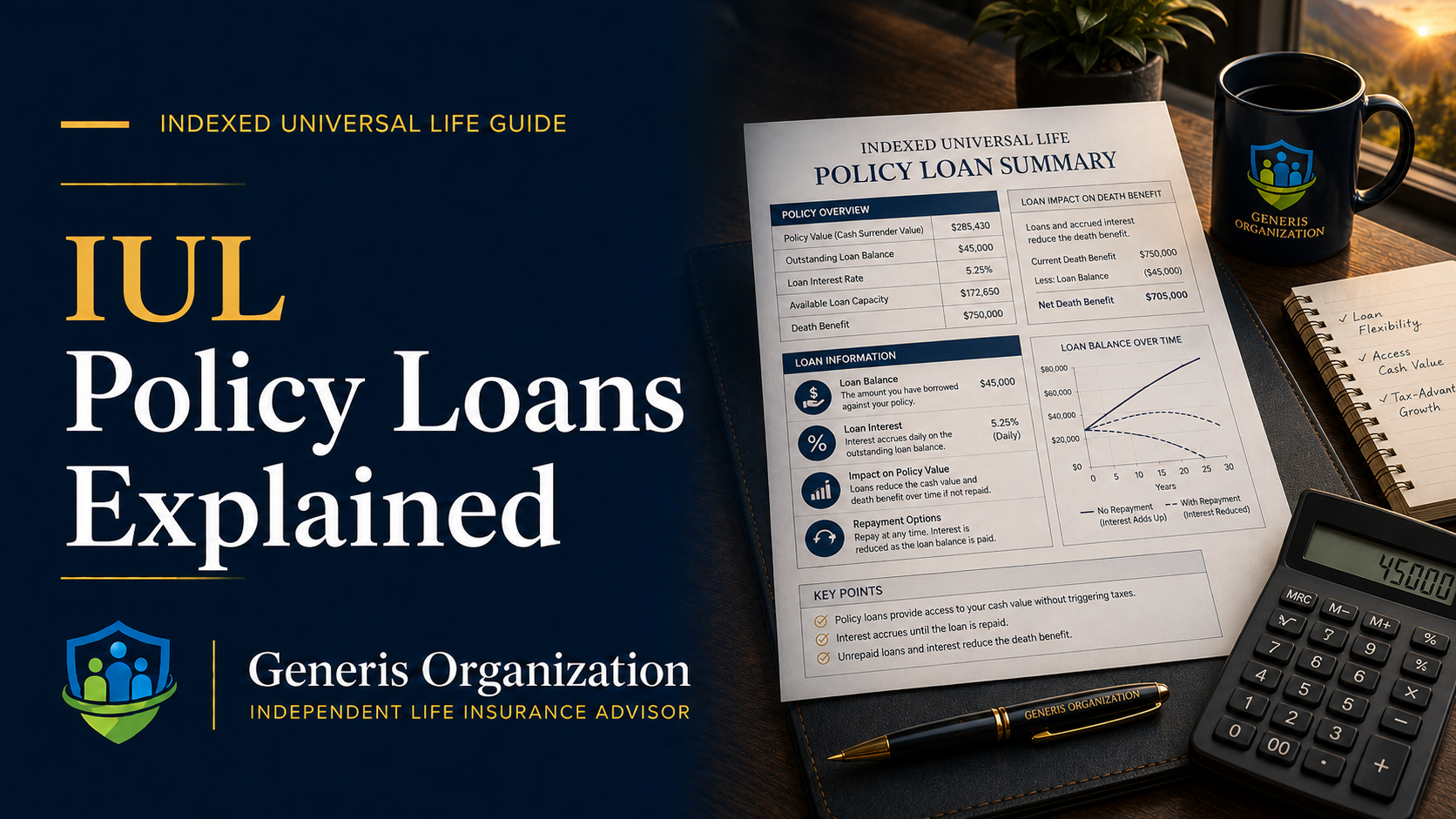

What is an IUL policy loan?
An indexed universal life (IUL) policy loan is a loan made under the terms of a life insurance policy. The policy's value supports the loan, but the policy contract—not a general rule about IUL—sets the available amount, interest method, and other conditions.
A policy loan is different from a typical consumer loan. It is connected to the insurance contract and is generally secured by policy value. That does not mean every insurer skips the same credit checks, uses the same process, or offers the same repayment terms. Check your contract and current carrier materials.
This guide assumes you already know the basic parts of an IUL. If those terms are new, start with what an IUL is and how it works.
How an IUL policy loan generally works
The exact process varies, but these steps can help you understand the documents:
- You request a loan. The insurer determines whether the policy has enough value under its contract rules and applies any request procedures or minimums.
- The insurer records principal. Principal is the amount borrowed before interest. The way the policy accounts for that amount depends on the contract and loan option.
- Interest accrues. Accrued interest means interest that has built up over time. The rate may be fixed or may change if the contract permits it.
- Payments may reduce the balance. Contract rules determine how repayments are accepted and applied.
- You monitor the policy. The loan, interest, policy charges, credited interest, premiums, withdrawals, and benefit changes may affect later values.
Do not assume that another policy's timing, minimum amount, loan option, rate, or repayment process applies to yours. Ask the insurer which current form or disclosure explains each rule.
Where does the policy-loan money come from?
People sometimes describe a policy loan as “borrowing your own money.” That phrase is incomplete and can be misleading. Policy value supports or secures the loan, while the insurer provides proceeds under the policy's loan provisions.
What happens inside the policy after the loan is made is product-specific. One contract may move an amount to a loan collateral account. Another loan option may leave an amount associated with an eligible indexed account. Similar-sounding options may use different accounting rules.
This distinction matters because the loan balance and the policy's values are related but are not the same number. Verify:
- which policy value determines the available loan amount;
- whether value is moved between accounts;
- how loaned and unloaned amounts are credited;
- which charges and interest continue; and
- how the loan changes cash surrender value and benefits.
How IUL policy-loan interest works
The stated loan interest rate is the rate used to calculate interest on the outstanding loan under the contract. Some policies describe a fixed rate. Others permit an adjustable or variable rate. The contract should explain how the rate is set and whether it can change.
Accrued interest is interest that has built up but has not yet been paid. If the contract allows unpaid interest to be added to the loan, the outstanding balance can grow. Later interest may then be calculated on a larger balance.
Hypothetical example: All numbers are hypothetical. This is an arithmetic and document-reading demonstration only. It is not a carrier illustration, not a current carrier rate, not a recommendation, and not expected performance.
Assume a hypothetical $10,000 loan and a hypothetical 5% annual interest rate solely to demonstrate arithmetic. If no interest is paid during that year, $500 of interest would accrue, producing a hypothetical $10,500 balance before considering any other timing or contract rules. A real policy may calculate interest differently.
The loan rate alone does not show the policy's net result. Policy charges, premiums, loan-account crediting, indexed crediting, withdrawals, and other activity can also affect value.
How a policy loan may affect policy values
A policy loan may affect several values at once. The direction and timing depend on the contract and loan option.
| Policy area | Possible effect | What to monitor |
|---|---|---|
| Account value | Loan accounting or credited interest may change how parts of the value grow. | Loan and unloaned accounts, credits, deductions, and contract definitions. |
| Cash surrender value | The net amount available after ending the policy may be lower. | Outstanding principal, interest, surrender charges, and other deductions. |
| Death benefit | An outstanding balance may reduce what beneficiaries receive. | The contract's death-claim calculation and current net benefit. |
| Loan balance | Unpaid interest may increase the balance. | Rate, accrued interest, payments, and annual statements. |
| Policy duration | A large or growing balance may reduce the value supporting coverage. | In-force illustrations, premiums, charges, and lapse notices. |
| Tax outcome | Lapse or surrender with gain and debt may have tax consequences. | Policy basis, MEC status, outstanding debt, and professional tax advice. |
Hypothetical example: All numbers are hypothetical. This is an arithmetic and document-reading demonstration only. It is not a carrier illustration, not a current carrier rate, not a recommendation, and not expected performance.
Suppose a document shows a hypothetical $60,000 account value, a $20,000 outstanding loan balance, and a $36,000 cash surrender value. Do not assume the available amount is simply $60,000 minus $20,000. The difference may also reflect surrender charges, accrued interest, or other contract deductions. Use the example to identify which figures need explanation.
Fixed, variable, indexed, participating, and other loan terms
Carriers use different labels for policy-loan options. The label is a starting point, not a complete explanation.
| Term | Plain-language meaning | What to verify |
|---|---|---|
| Principal | The amount borrowed before interest. | Available amount and the date the balance begins. |
| Outstanding balance | Unpaid principal plus any interest added under the contract. | Current statement balance and how payments are applied. |
| Fixed-rate loan | A label generally indicating a stated loan rate, subject to the exact contract. | Whether the rate is guaranteed and for how long. |
| Variable-rate loan | A label generally indicating that the loan rate can change. | The benchmark, adjustment dates, minimum, and maximum. |
| Indexed or participating loan | A product-specific option that may connect crediting on designated value to an index-based method. | Which account is used, the loan charge, crediting formula, limits, and guarantees. |
| Accrued interest | Interest that has built up but has not been paid. | When it is due or added to the balance. |
| Cash surrender value | The net amount available if the policy ends. | How the loan, interest, and surrender charges affect it. |
| In-force illustration | An updated projection using current policy information and stated future assumptions. | Loan amount, rate, repayment, premium, and crediting assumptions. |
Current carrier materials show why product-specific wording matters. For example, one product family distinguishes standard and alternate loans, while another offers a separate indexed-loan agreement. Those examples do not establish universal definitions. Do not choose an option by its headline label alone.
Does borrowed value still receive indexed interest?
The safe answer is: it depends on the policy and loan option.
Some contracts may move an amount associated with a loan to a separate account with its own crediting rules. Some product-specific loan options may leave eligible value exposed to an indexed-crediting method. Other designs can work differently.
Ask four separate questions:
- Where is the value associated with the loan held?
- What interest, if any, may be credited to that value?
- What loan interest is charged?
- What charges and other policy activity affect total value?
Even when a designated value can receive an indexed credit, that credit is not guaranteed unless the contract says so. It may be less than the loan interest charged, and it is not the same as the policy's net cash-value return. For the underlying crediting terms, see IUL caps, floors, and participation rates.
Do IUL policy loans have to be repaid?
A policy loan may not have the same scheduled monthly payments as a typical bank loan, but “you never have to repay it” is not a safe explanation.
The contract determines whether and when payments are required, accepted, or applied. If a balance remains outstanding, interest may continue to accrue. That balance may affect cash surrender value, the amount paid at death, and the value available to keep the policy in force.
Before making a payment, ask whether the insurer will treat it as loan repayment, premium, or another transaction. Keep confirmation of how it was applied. If your plan assumes that a loan will remain outstanding, request an updated in-force illustration using that assumption and compare it with a no-loan or repayment scenario.
How can a policy loan affect the death benefit?
An outstanding policy loan and accrued interest may reduce the amount beneficiaries receive. The exact calculation depends on the policy, benefit option, other activity, and contract language.
Hypothetical example: All numbers are hypothetical. This is an arithmetic and document-reading demonstration only. It is not a carrier illustration, not a current carrier rate, not a recommendation, and not expected performance.
Assume a document shows a hypothetical $500,000 death benefit and a hypothetical $35,000 outstanding loan balance. A simple reading illustration might show a $465,000 net amount. That is not a universal claim that every carrier subtracts the same items dollar for dollar. Accrued interest, riders, benefit-option rules, and other adjustments may change the actual claim calculation.
Ask the insurer for the current gross death benefit, outstanding principal, accrued interest, and estimated net death benefit under the policy's terms.
How policy loans can increase lapse risk
A life insurance policy generally needs enough value or other support to cover deductions required by the contract. A growing loan balance can place added stress on that support.
Loan interest may increase the balance. Policy charges may continue. If premiums or credited interest do not provide enough support, the value available to keep coverage active may fall. A withdrawal or another loan can add more pressure. This does not mean every policy with a loan will lapse, but it means the loan should be monitored.
A 0% indexed-crediting floor does not prevent total policy value from declining. A floor applies to a particular indexed-interest calculation under its terms. Loan interest, policy charges, withdrawals, and other activity can still reduce value.
Hypothetical example: All numbers are hypothetical. This is an arithmetic and document-reading demonstration only. It is not a carrier illustration, not a current carrier rate, not a recommendation, and not expected performance.
Suppose a hypothetical policy begins a year with $30,000 of value supporting coverage and a $20,000 loan. During the year, assume $1,000 of loan interest and $2,500 of policy charges, with no premium and no positive indexed credit. The example shows why both the loan balance and remaining policy value need attention. It does not predict when any real policy would lapse.
Review annual statements, notices, and updated in-force illustrations. Contact the insurer promptly if a notice says more value or premium is needed to prevent lapse.
What can happen if a policy lapses or is surrendered with a loan?
A lapse ends coverage because the policy no longer meets the contract's requirements. A surrender is the owner's decision to end the policy and receive any available cash surrender value.
Tax consequences can arise when a policy with gain ends while a loan is outstanding. A simplified comparison usually considers the amount treated as received and the owner's basis, generally the investment in the contract under federal tax rules. Basis is not always the same as total premiums paid because prior distributions and other adjustments can matter.
The outcome depends on the contract, outstanding debt, gain, prior activity, Modified Endowment Contract status, and individual facts. An owner can face taxable income even when little or no cash is received at lapse or surrender. This section is a warning to investigate—not a tax calculation.
What is a Modified Endowment Contract (MEC)?
A Modified Endowment Contract (MEC) is a life insurance contract that meets the federal definition in Internal Revenue Code section 7702A. MEC status changes the federal income-tax rules that can apply to loans and other distributions.
For a MEC, a loan, assignment, or pledge can be treated as a distribution under federal tax rules. The amount and consequences depend on the contract and facts. This is different from saying every loan from every life policy is taxable.
Ask the insurer whether the policy is classified as a MEC and whether past or planned changes could affect that status. Detailed MEC testing and tax planning are beyond this guide; use a qualified tax professional for advice.
How policy loans appear on an illustration or in-force illustration
An illustration may show assumed loan amounts, loan interest, repayments, withdrawals, cash surrender values, death benefits, and projected policy duration. An in-force illustration is an updated projection based on an existing policy's current information and stated assumptions.
Check when the loan begins, whether interest is paid or added to the balance, whether repayments are assumed, and which loan option is modeled. Then compare later values with a scenario that uses different loan assumptions.
An illustration is not the policy contract and does not predict actual performance. For a step-by-step document review, see how to read an IUL illustration.
Questions to ask before taking an IUL policy loan
| Question | Why it matters | Where to verify |
|---|---|---|
| What loan options are available? | Each option may use different interest and account treatment. | Policy, endorsements, and current loan disclosure. |
| What is the current interest rate, and can it change? | The rate affects how quickly the balance may grow. | Contract method and current carrier notice. |
| How is borrowed value treated? | Crediting and account movement can vary. | Contract definitions and product-specific disclosure. |
| How could surrender value change? | The amount available after ending the policy may fall. | Current statement and in-force illustration. |
| How could the death benefit change? | Beneficiaries may receive less while debt is outstanding. | Contract and current net-benefit estimate. |
| How is unpaid interest handled? | Added interest may increase the balance. | Loan provision and annual statement. |
| How are repayments applied? | A payment may need specific instructions. | Carrier service rules and written confirmation. |
| Could the policy lapse? | A growing balance and continuing charges may reduce policy support. | In-force illustration, notices, and carrier review. |
| What does an updated illustration show? | Loan assumptions may materially change projected values. | Current in-force illustration and its assumptions. |
| Could there be tax consequences? | MEC status, gain, lapse, surrender, and debt can matter. | Insurer records and a qualified tax professional. |
Policy loans can be useful in some circumstances, but they require careful contract review and ongoing monitoring. Broader tradeoffs belong in our balanced guide to IUL pros and cons.
If you want help reviewing the loan provisions and assumptions in an actual policy or in-force illustration, you can request a low-pressure personalized IUL review. The goal is to understand the contract and possible effects—not to promise a borrowing result, tax outcome, or future performance.