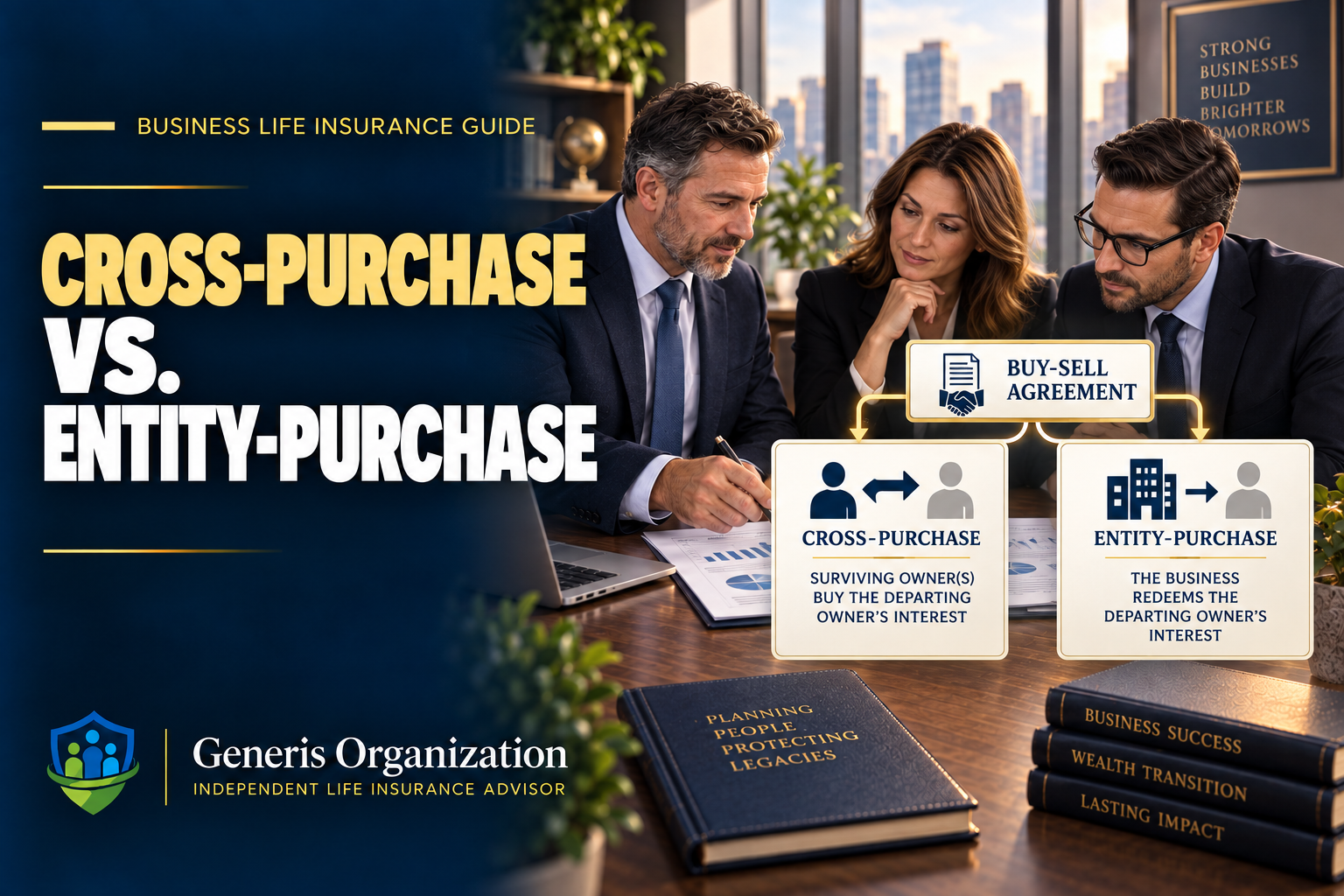
Cross-Purchase and Entity-Purchase arrangements solve the same basic funding problem in different ways. A Cross-Purchase structure generally puts ownership and purchase responsibility with the individual owners. An Entity-Purchase structure generally puts policy ownership, proceeds, and the purchase obligation with the business.
The labels are a starting point, not a complete design. Entity form, tax classification, ownership percentages, owner count, age and health differences, policy transfers, and the actual Buy-Sell Agreement can materially change the result.
Scope note: This guide provides general insurance education, not legal, tax, accounting, valuation, or estate-planning advice. Business owners should coordinate the agreement, valuation, tax treatment, and policy ownership with qualified professionals.
What Is a Cross-Purchase Agreement?
In a traditional Cross-Purchase Buy-Sell arrangement, each owner agrees to purchase another owner's interest after a triggering event described in the agreement. To fund a death-triggered purchase, the owners generally own life insurance policies on one another, pay the premiums, and are beneficiaries of the policies they own.
After a covered owner's death, the surviving owner or owners receive policy proceeds and use available funds to purchase the deceased owner's interest from the estate or other seller under the agreement. The buyer then holds the acquired interest directly.
The insurance should support the obligation created by the agreement; it does not create the legal purchase obligation by itself.
What Is an Entity-Purchase or Redemption Agreement?
In an Entity-Purchase arrangement, the business generally owns life insurance on each covered owner, pays the premiums, receives the death benefit, and purchases the deceased owner's interest under the agreement.
For a corporation, this purchase is commonly called a stock redemption because the corporation redeems the deceased shareholder's stock. Entity-Purchase is the broader term: an LLC or partnership may purchase a deceased member's or partner's interest even though the interest is not corporate stock. The entity's legal form and federal tax classification are related but separate questions.
Cross-Purchase vs. Entity-Purchase: Side-by-Side Comparison
| Planning point | Cross-Purchase | Entity-Purchase / Redemption |
|---|---|---|
| Policy owner | Generally the other owner or owners. | Generally the business entity. |
| Premium payer | Generally the policy-owning individual owners. | Generally the business. |
| Beneficiary | Generally the other owner or owners. | Generally the business. |
| Who purchases the interest? | The surviving owner or owners. | The business purchases or redeems the interest. |
| Policy count | Traditional owner-on-owner structures can require N × (N - 1) policies. | Commonly one policy per covered owner. |
| Administrative complexity | Can rise quickly as owners are added or removed. | Often simpler to administer centrally. |
| Basis implications | The purchase price generally becomes part of the buyer's cost basis in the acquired interest. | Remaining owners do not automatically receive the same direct cost basis from an entity redemption. |
| Employer-owned rules | May be less likely to apply when individuals own the policies, but facts control. | Section 101(j) notice, consent, exceptions, recordkeeping, and reporting may apply. |
| Owner changes | May require several new policies or transfers of existing policies. | May require adding or changing an entity-owned policy. |
| Premium disparities | Age, health, coverage amount, and ownership percentage can create unequal costs among owners. | The entity commonly pays the premiums, but economic allocation and fairness still require review. |
| Connelly consideration | The business generally does not own the policies in the traditional structure. | Entity-owned proceeds can affect business and estate-tax valuation; the redemption obligation did not offset value in Connelly. |
Neither structure is automatically better. The right fit depends on the agreement, ownership group, entity and tax structure, business value, administration, insurability, and the owners' legal and tax objectives.
How Does the Money Move?
Cross-Purchase cash flow
The surviving owner receives the policy proceeds from a policy the surviving owner owns, then pays the seller or estate for the deceased owner's interest under the agreement.
Entity-Purchase cash flow
The business receives proceeds from a policy the business owns, then pays the seller or estate to acquire or redeem the deceased owner's interest under the agreement.
The death benefit and purchase price are not automatically identical. Valuation provisions, ownership percentage, existing funding, insurer limits, debt, and the agreement's payment terms all need to be coordinated.
How Many Policies Are Needed?
A traditional owner-on-owner Cross-Purchase design may require N × (N - 1) policies, where N is the number of owners. Each owner owns a separate policy on every other owner.
| Number of owners | Calculation | Policies | Entity-Purchase comparison |
|---|---|---|---|
| 2 owners | 2 × 1 | 2 | Commonly 2, one per owner |
| 3 owners | 3 × 2 | 6 | Commonly 3, one per owner |
| 4 owners | 4 × 3 | 12 | Commonly 4, one per owner |
| 5 owners | 5 × 4 | 20 | Commonly 5, one per owner |
This is a traditional pattern, not a universal rule. A trusteed Cross-Purchase arrangement, partnership-based structure, special-purpose entity, or other advanced design may reduce policy count or change ownership. Those alternatives introduce separate legal, tax, fiduciary, and administrative questions.
What Changes With Three or More Owners?
Policy count is only one concern. With three or more owners, the agreement must address how each surviving owner participates in the purchase, how proceeds and ownership interests are allocated, what happens if one buyer cannot perform, and whether the result preserves the intended post-transaction ownership percentages.
Underwriting can also become uneven. One owner may qualify for preferred pricing while another is rated or uninsurable. A structure that looks symmetrical on paper may produce unequal premium burdens or a funding gap in practice.
How Does Unequal Ownership Affect the Structure?
Equal face amounts do not necessarily match unequal purchase obligations. If owners hold 60%, 25%, and 15%, the required funding depends on whose interest is being purchased, who is required to buy it, and how the agreement allocates the purchase among survivors.
Cross-Purchase premiums may also be unequal when a younger or healthier owner pays for coverage on an older owner while the older owner pays more or less for coverage on the younger owner. Entity payment may simplify cash flow, but it does not eliminate the need to evaluate economic fairness, compensation, distributions, or tax treatment.
What Happens When an Owner Leaves or a New Owner Joins?
Ownership changes should trigger a coordinated review of the agreement and every policy. A departing owner's policy may be retained, surrendered, transferred, or repurposed depending on the agreement, business need, carrier rules, consent, and tax advice. A new owner may require new coverage and underwriting.
Transferring a policy between owners or between an owner and the business can create transfer-for-value concerns. Never assume an internal business transfer is tax-neutral merely because the parties know one another or the insured remains connected to the business.
How Can the Structure Affect Basis?
Use precise language here: a purchaser may acquire cost basis in the acquired interest. That is not an automatic step-up of every ownership interest, and the result differs by transaction and tax classification.
| Business tax structure | Cross-Purchase consideration | Entity-Purchase consideration |
|---|---|---|
| C corporation | A shareholder's purchase price generally contributes to basis in the stock acquired. | A corporate redemption generally does not give remaining shareholders direct purchase-price basis in the redeemed shares. Section 302 determines whether the seller's redemption is treated as a sale or exchange or as a distribution. |
| S corporation | The purchasing shareholder generally has cost basis in the acquired stock. | Tax-exempt income, including qualifying death proceeds, may affect shareholder stock basis through the S corporation rules, but the redemption and distribution consequences still depend on Sections 302, 1367, 1368, and the facts. |
| Partnership-taxed LLC or partnership | A buyer generally has cost basis in the acquired partnership or membership interest, subject to partnership tax rules. | Tax-exempt proceeds may affect partners' outside basis, while entity-level asset basis and purchase or distribution consequences can involve Sections 705, 732, 734, 742, 743, and any Section 754 election. |
| LLC legal form | “LLC” describes a state-law entity form, not a single federal tax classification. An LLC may be taxed as a disregarded entity, partnership, S corporation, or C corporation, so “LLC basis treatment” is not one universal rule. | |
This table is a planning prompt, not a tax conclusion. Ownership, the seller's status, distributions, elections, purchase documents, and the timing of proceeds can change the analysis.
What Did Connelly v. United States Change?
In the 2024 Supreme Court case Connelly v. United States, two brothers owned a closely held building-supply corporation. Their agreement allowed the corporation to redeem a deceased brother's shares, and the corporation owned life insurance intended to fund the purchase. After Michael Connelly died, the parties valued his shares at $3 million for the redemption. The estate-tax dispute asked whether the corporation's redemption obligation reduced corporate value.
The Supreme Court unanimously held that the redemption obligation was not a liability that reduced the corporation's value for the valuation at issue. A fair-market-value buyer would account for the life insurance proceeds held by the corporation, and redeeming shares at fair market value does not by itself reduce the remaining shareholders' economic interests.
What Connelly does not mean: It does not mean every Entity-Purchase arrangement is invalid, every entity-owned policy is a mistake, Cross-Purchase is always superior, or every business will owe estate tax. It means entity-owned insurance, redemption terms, valuation, and estate exposure should be reviewed together.
Federal Tax Guardrails to Keep in View
- Section 101(a): Life insurance amounts paid by reason of death are generally excluded from gross income, subject to statutory exceptions and special rules.
- Section 264: Premiums are generally not deductible when the taxpayer is directly or indirectly a beneficiary, with the Code's detailed rules and exceptions controlling.
- Section 302: A corporate redemption may receive sale-or-exchange treatment or distribution treatment depending on ownership changes, attribution, waivers, and other facts.
These are guardrails, not a tax opinion. State taxes, alternative minimum tax issues, entity-level rules, accumulated earnings, distributions, and estate circumstances may also matter.
Entity-Owned Policies: Notice, Consent, and Form 8925
Section 101(j) can limit the exclusion for proceeds from an employer-owned life insurance contract unless an exception applies and the statutory requirements are satisfied. Before policy issue, the employee generally must receive written notice of the intended coverage and maximum face amount, and provide written consent to being insured and to coverage continuing after employment ends.
Section 6039I generally requires an applicable policyholder that owns one or more employer-owned contracts to report specified information annually. Form 8925 is the IRS form used for that report. IRS Notice 2009-48 provides question-and-answer guidance on Section 101(j), Section 6039I, notice and consent, and reporting. Business owners should establish the process before applying rather than trying to reconstruct consent after issue.
Why Does the Transfer-for-Value Rule Matter?
Section 101(a)(2) can limit the income-tax exclusion when a life insurance contract or an interest in it is transferred for valuable consideration, unless a statutory exception applies. Changes among owners, a business, a partnership, or a trust can create a transfer even when no public sale occurs. The exceptions are technical and were affected by later reportable-policy-sale rules, so a qualified tax professional should review a proposed transfer before it occurs.
Should the Funding Use Term or Permanent Life Insurance?
Term Life Insurance may fit a defined planning horizon and generally has a lower initial premium, but the owners need to consider whether the obligation could outlast the term or become costly to renew. Whole Life Insurance and Indexed Universal Life are permanent-policy options with different guarantees, funding requirements, cash-value mechanics, and risks.
No product type fixes an agreement or ownership mismatch. Coverage duration, guarantees, premium responsibility, potential policy value, and the expected life of the business arrangement should be reviewed together.
Buy-Sell Funding Is Not Key Person Protection
Buy-Sell Life Insurance is intended to help fund an ownership-transfer obligation. Key Person Insurance addresses the separate economic loss the business could face after losing an important owner, executive, employee, or revenue producer.
The Key Person Insurance Calculator organizes assumptions about that separate Key Person exposure. It is not a business valuation and does not calculate a Buy-Sell purchase obligation. A single owner can create both risks, but each amount should be evaluated for its own purpose within the broader Business Life Insurance plan.
Professional Review Checklist
- Does the legal agreement identify the buyer, seller, trigger, valuation method, and payment terms?
- Does policy ownership match the party expected to receive proceeds and make the purchase?
- Are coverage amounts aligned with current value and ownership percentages?
- How will premiums and economic disparities be handled?
- What happens when an owner leaves, joins, becomes uninsurable, or changes ownership percentage?
- Have transfer-for-value consequences been reviewed before any policy transfer?
- For entity-owned coverage, were Section 101(j) notice and consent completed before issue?
- Who is responsible for Form 8925 and related records?
- Has the CPA modeled basis, redemption, distribution, and entity-specific consequences?
- Has estate counsel reviewed the valuation and estate-tax implications after Connelly?
- Does the funding plan distinguish the Buy-Sell obligation from Key Person, debt, and family needs?
- When will the agreement, valuation, and insurance be reviewed again?
Authoritative Sources and Further Reading
Authoritative legal and tax references include the U.S. Supreme Court's opinion in Connelly v. United States; Internal Revenue Code Sections 101 and 101(j), 264, 302, 1367, and partnership-basis provisions including 705, 742, and 743; the IRS overview of life insurance proceeds; Notice 2009-48; Section 6039I; and Form 8925. For carrier explanations of common mechanics, see guidance from Guardian and MassMutual. Carrier materials illustrate general mechanics and do not determine another transaction's legal or tax result.